
Program
Home » Program
Program
The 14th Cities on Volcanoes conference will be hosted under the caption: “Living on the edge. The disaster management cycle in volcanic regions” with 5 main themes, all defined with the goal of supporting inter- and cross-disciplinary attendance at sessions.
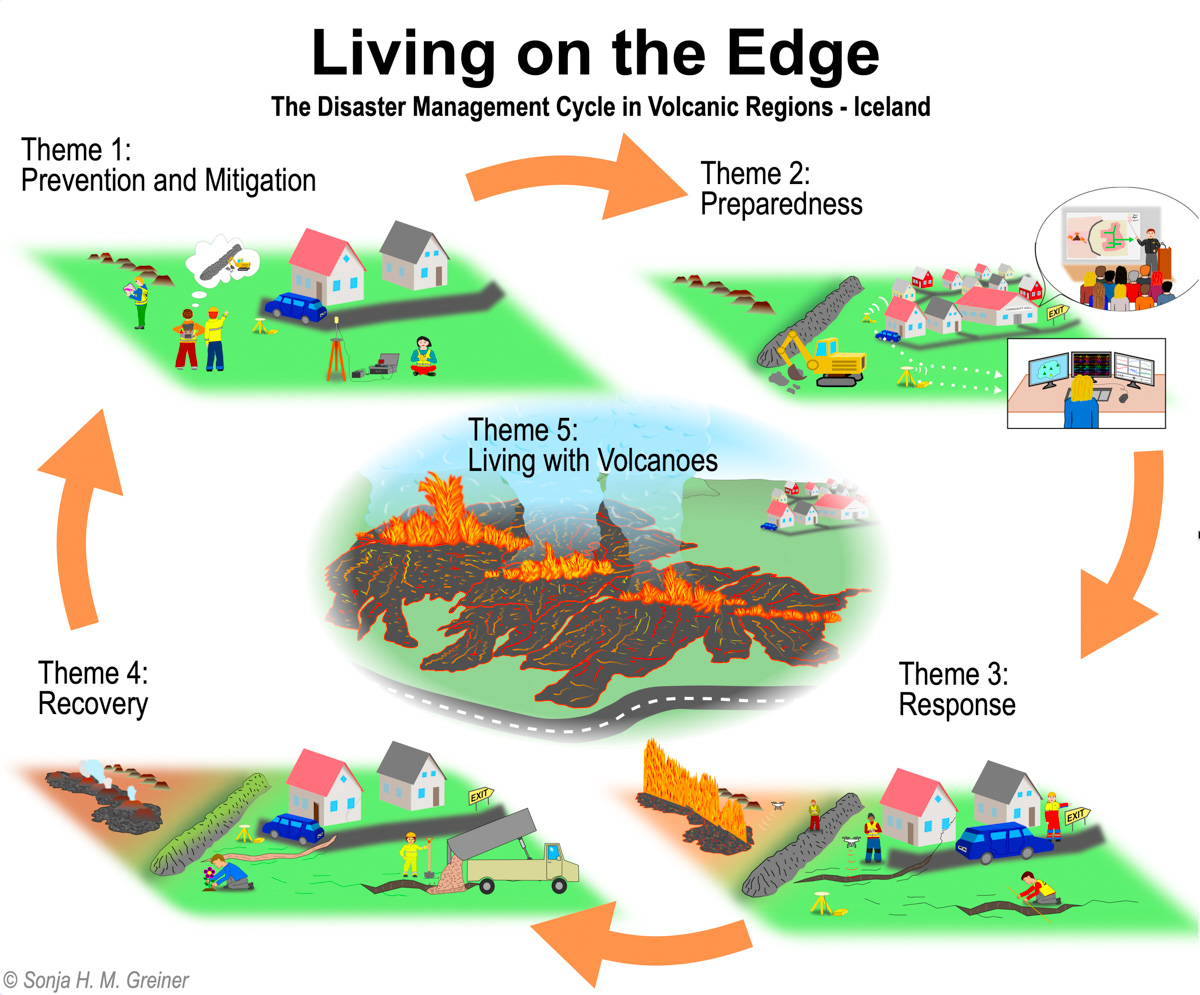
Theme 1: Prevention and mitigation (long-term planning)
Prevention and mitigation are key elements of the disaster management cycle, where the main purpose is to minimize the possible effects of a potential hazard. In order to set up a plan to minimize the effects of a phenomenon it is imperative to acquire as much background information as possible. However, prevention is not only scientific forecasting, but requires governance, community engagement, and economic tools. In that way it aligns with climate adaptation and sustainable development. Prevention and mitigation strategies strengthen long‑term resilience of volcanic communities through science and planning.
The theme will bring together volcanologists, engineers, urban planners, economists, and social scientists to discuss risk‑reducing systems, and encourages integration of hazard models with land‑use planning, infrastructure design, and environmental management, thereby supporting collaboration between natural sciences and policy/legal frameworks for zoning, insurance, and building codes.
Theme 2: Preparedness (short-term planning)
The preparedness of a community, which may potentially be subjected to a natural catastrophe, depends inherently on the existing response plans. Preparedness unites science, emergency management, communication, and education. This conference theme therefore connects monitoring agencies, researchers, educators, psychologists, communication specialists and civil protection.
Preparedness encourages co‑production of awareness materials with communities, including local knowledge and in some cases indigenous aspects. It furthermore integrates social science insights on trust, risk perception, and behavior. In terms of cross disciplinarity, preparedness is where scientific uncertainty meets human decision‑making, which in turn requires collaboration between technical experts and those who understand how people interpret warnings.
Theme 3: Response
In this theme the goal is to shed light on the possible actions to mitigate the effects of multi-hazards in relation to an ongoing disaster, bringing together crisis science, emergency operations, logistics, and communication. This theme will ensure that scientific contributions are directly connected to operational needs.
Witin the response theme real‑time monitoring experts will be linked with emergency management, humanitarian response teams, media studies, and public health. It furthermore encourages joint actions with scenario planning across disciplines and highlights the role of data science, and remote sensing in rapid decision‑making, where effective responses require synchronized action across institutions and knowledge systems.
Theme 4: Recovery
The recovery phase is often the least studied in volcanic disasters, yet it shapes future vulnerability. It integrates social science, economics, governance, and environmental restoration, through both short- and long-term studies of displacement, resettlement, livelihood recovery, and mental health.
In the recovery phase, studies on reestablishing of infrastructure, (re)establishment of ecosystems, and cultural landscapes are supported, encouraging longitudinal research and community centered approaches. With the eruption in Heimaey in 1973, along with the current events in and near Grindavík, Iceland is well equipped to showcase both short-term and long-term recovery within this theme, together with potential international contributions.
Theme 5: Living with Volcanoes
The fifth and final theme is creative, cultural, and holistic, intended to shed light on positive and creative energies that may arise from living in a highly dynamic geological setting, such as that of an active volcanic region.
The sessions will focus on how volcanoes can act as inspiration, creativity and arts, knowledge dispersion, science communication, flexible societies, volcanic benefits (geothermal, geo-tourism), and psychological aspects: Growing up with volcanoes versus moving to a volcanically active area, how to use the creative arts to further interest the general public and disseminate scientific knowledge.